Showing posts with label philosophy. Show all posts

Friday, January 10, 2014

Doubt your doubts?

I've been thinking about the nature of doubt a lot recently, as it keeps coming up in all of the things I'm reading. The more I take in, the more I begin to see the discussion fall into a very simple patterns. Doubt seems to take one of two personas depending upon who is the descriptor: the ally and guide to knowledge, or the enemy and tool of the devil.

I consider doubt to be my primary guide in seeking new understanding and, more often than not, self correction. When a doubt arises, I consider it good cause to dive deeper into my beliefs and either replace my doubt with clarification or justify my earlier intuition of the belief's falsity. Doubt acts as a companion in this way, warning me away from falling easily into credulity.

This is not to say that doubt is omniscient or always legitimate. Doubt should be the nagging question not the final answer.

However, in my former community of believers doubt is an entirely different beast. Doubt is evil. Doubts are there to be combated and replaced with faith. Doubts are the devil's work.

Lest you think I exaggerate the position, allow me to furnish you with several examples from prominent believers.

Tim Keller directly describes how believers should approach doubt in his book "The Reason for God": doubt your doubts.
"The only way to doubt Christianity rightly and fairly is to discern the alternate belief under each of your doubts and then ask yourself what reasons you have for believing it. How do you know your belief is true? It would be inconsistent to require more justification for Christian belief than you do for your own, but that is frequently what happens. In fairness you must doubt your doubts. My thesis is that if you come to recognize the beliefs on which your doubts about Christianity are based, and if you seek as much proof for those beliefs as you seek from Christians for theirs – you will discover that your doubts are not as solid as they first appeared."-Tim Keller, The Reason for God (pg. xix)
Joyce Meyer writes in an article entitled "How to Defeat Your Doubts and Feed Your Faith":
I struggled with two things the devil often threw at me: doubt and unbelief.
Doubt and unbelief are big problems for Christians. They are negative and discouraging. They cause us to make poor choices, which make life difficult. They cause us to say things like, “I wish I could lose weight,” or “I wish my kids would behave,” or “I wish I could keep my house clean,” or “I wish I had better relationships.” 
And doubt and unbelief interrupt faith. 
Every day you need to say, “Something good is going to happen to me today. I can hardly wait to see what God is going to do in my life today!” 
And you especially need to speak this when the devil is trying to flood your mind with doubts. The way you fight the devil is by opening your mouth and saying what God says. Don’t just let the devil use your mind as a garbage dump. 
We can defeat doubt and unbelief if we know how to do it.

Refuse to be a lazy Christian and resist a passive, apathetic attitude. Be determined to do your part to build your faith. Never give up. And you will defeat doubt and unbelief!
Nowhere is the concept of doubt more corrosive to belief than in the Church of Jesus Christ of Latter Day Saints. Hence why President Dieter F. Uchtdorf felt the need to make this statement:

It’s natural to have questions—the acorn of honest inquiry has often sprouted and matured into a great oak of understanding. There are few members of the Church who, at one time or another, have not wrestled with serious or sensitive questions. One of the purposes of the Church is to nurture and cultivate the seed of faith—even in the sometimes sandy soil of doubt and uncertainty. Faith is to hope for things which are not seen but which are true. 
Therefore, my dear brothers and sisters—my dear friends—please, first doubt your doubts before you doubt your faith. We must never allow doubt to hold us prisoner and keep us from the divine love, peace, and gifts that come through faith in the Lord Jesus Christ.
William Lane Craig takes a similar approach to doubt:

Craig suggests that since we know in a self authenticating manner "wholly apart from the evidence" that the witness of the holy spirit is accurate and true, that we should regard doubt.as a temporary setback caused by our lack of access to the full set of evidence for that obvious truth. The "shifting sands of evidence" are a poor basis for our beliefs, according to Craig.  He also claims that doubt always has a spiritual component.
"There is an enemy of your souls, Satan, who hates you intensely, bent on your destruction who will do everything in his power to see that your faith is destroyed. And therefore when we have these intellectual doubts and problems we should never look at them as spiritually neutral or divorce them from the conflict that we are involved in. Rather we need to take those doubts to God in prayer...[that's how] you allow unanswered questions not to become destructive doubts."
Let us leave aside the repeated claims are tools of Satan for the time being and consider how all of these leaders suggest approaching doubt. The common thread is to see doubt as something that must be defeated. Doubts are never even possibly correct. Doubts must be driven into the ground or taken to God because doubt is WRONG! Doubts are destructive and must never be heeded.

This crusade against doubt can rightly be called the armor of god.  It is the first and last line of defense to inquiry and questioning. The vilification of doubt often makes believers ashamed of their questions and hesitant to voice them openly. It provides a deflector shield to questionable beliefs.

However, this view of doubt creates a downside from the religious perspective. It transforms a potentially malleable and adaptable worldview into a rigid structure of unquestionable dogma. In such a state the worldview is strengthened against critique, but when a weakness is found the entire lattice risks shattering. When your entire worldview is held above reproach, the admission of a single failing belief can lead to the decimation of the entire house of cards.

It should be no surprise then that many of the most enthusiastic atheist and freethinking activists came from such rigidly mind controlled backgrounds. Nor should we be surprised that the path from fundamentalism to non-belief is much more worn than that from fundamentalism to liberal theology (the latter route being taken often as a scenic tour to the former's destination).

No one better personifies and understands this risk than Ken Ham of Answers in Genesis. He understands the importance of defending his worldview's weak spot: young earth creationism. Ham is often quite explicit that if Genesis is not inerrant and literally true, then the rest of the Bible quickly falls into doubt.

So to my believing audience, I make this suggestion: accept doubt into your heart. If your beliefs are true, they should fear nothing from scrutiny. Even if they are false, the willingness to adapt your views and unlearn errant teachings only makes your worldview stronger.

In either case, doubt should be nothing to fear.

Tuesday, February 26, 2013

Scientism and other Straw Men

Ian Hutchinson is participating at a Veritas Forum event here at University of Pennsylvania tomorrow and I've been doing a fair amount of research in preparation for the discussion afterwards.

Hutchinson typically has only one issue that he talks about: "Scientism."


Scientism as Hutchinson defines it is "the belief that the only meaningful knowledge is science." Even though he readily admits that almost no one says that's their position, he still believes it is pervasive in our culture.

But Hutchinson, as an applied physicist, clearly defines science to be only the "hard" natural sciences like Physics and Chemistry. Defined this way, clearly there is knowledge beyond science and believing science can explain everything is absolutely ridiculous.

But whenever Hutchinson gives an example of "scientism" they invariably means something entirely different by "science." Usually when a freethinker or skeptic refers to science, we mean science in a much broader sense: a systematic method of discerning knowledge while accounting for cognitive biases. Psychology, history, and sociology for example (fields at which science is incompetent according to Hutchinson) are systematic academic disciplines that produce experimental results that can be externally verified just like any hard science.

Even then, most skeptics wouldn't say science is the only way of knowing (though we'll often say justifiably that it's the best we've come up with so far).

It seems to me that Hutchinson is setting up a strawman in all sincerity. I accept that he believes scientism is a big problem in our society, but I also think he is completely wrong and attacking a boogieman.


So why is he doing it? What's his motivation? Why continue to push this one issue to the exclusion of all others?

To understand, I think we have to look more broadly at attempts to reconcile faith with science. In general, I've observed five different approaches to this problem that fall roughly on a spectrum.

1. Faith should be discarded outright (Harris, Dawkins, etc)
First is the common view among the New Atheists that in the conflict between science and faith, science should always win. Moreover, since this is always the case and science is getting better and better, why preserve faith at all?

2. Science's presumption of naturalism is too restrictive. We should allow supernatural explanations into science (Behe/Intelligent Design)
Proponents of this reconciliation argue that science restricts itself unnecessarily to naturalism and should begin to include supernatural elements. "If the actual answer is beyond the natural world," they reason "why should science be forever forbidden from accepting that?" This is a ploy to capitalize on the popularity and success of science. While they still privately hold to faith as the primary source of their knowledge in these realms, they believe that science would justify their faith if only it where not constrained to what we can observe, test, and falsify. 

3. Science and Faith are Non-Overlapping MagisteriA (NOMA/Gould).
Steven J Gould is the most well known popularizer of NOMA, arguing that faith deals in realms science can't touch (the supernatural) and at the same time faith doesn't touch the natural realm where science is king. On this view, questions of faith can't be formulated scientifically so they cannot be in conflict.


4. Shrink science with accusations of scientism and restrict it to the hard sciences (Hutchinson)
People taking this track will hold up science as a paragon of human ingenuity and progress, but only in very narrow specific fields. Meanwhile, they will paint every other field as inaccessible to science. They claim that science has exploded the boundaries of its validity when it tries to address historical claims (like can a dead man come back to life), sociological claims (like is religion purely a product of culture), psychological claims (like is glossolalia meaningless babble).

See the pattern here? Hutchinson is an extreme example of this because he narrows science so much, but many religious scientists make valiant attempts to keep some gap in scientific knowledge available for God to act in the world. Ken Miller for example leaves the randomness of quantum mechanics up to God's will, by which he can control all of reality through subtle undetectable methods.


5. Discard science altogether (Answers in Genesis) 
This is the young earth creationist approach of decrying science as a flawed human endeavor and holding up faith and revelation as the only valid path to knowledge.


Except for the first and last approaches that completely reject one or the other, each of these tries to rectify the apparent conflict between faith and empiricism without destroying either. Why has Hutchinson gone with option 4? Because he recognizes that including supernaturalism into science (a la Behe) would destroy it utterly, and as a scientist he doesn't want that. Instead, he wants to leave room for Purpose in a world that could potentially be described in a completely deterministic and purposeless way. 

By barring science from touching on any human characteristics such as imagination, judgement, morality, free will, or meaning of life, he intends to leave the door open for God to enter in with those answers.

Sunday, January 20, 2013

Tim Keller's No True Christian Sermon

As I mentioned earlier I attended Redeemer Presbyterian Church in NYC today, and Dr. Tim Keller was actually there to give the sermon. I've always liked Keller's style, voice, manner, politeness, and tendency to tailor his sermons towards skeptics and acknowledge our existence.

But today he struck against one of my few remaining triggers: "You were never a true Christian."

I haven't told my full story before and I should do that someday, but the short version is I was heavily into apologetics, Youth for Christ, theology, worship, and really did believe what I was being taught outside of a few details.  I intentionally put myself through so many unneeded struggles because of my faith and actively sought Jesus out. I wanted him to be a part of my life. I was a believer.

So when someone explains away my entire tumultuous journey with a meaningless platitude I have a tendency to lose my shit.

I've lost count of how many times this verse and others like it have been offered as a complete explanation of my conversion.
18 The wrath of God is being revealed from heaven against all the godlessness and wickedness of people, who suppress the truth by their wickedness, 19 since what may be known about God is plain to them, because God has made it plain to them. 20 For since the creation of the world God’s invisible qualities—his eternal power and divine nature—have been clearly seen, being understood from what has been made, so that people are without excuse.
21 For although they knew God, they neither glorified him as God nor gave thanks to him, but their thinking became futile and their foolish hearts were darkened. 22 Although they claimed to be wise, they became fools -Romans 1:18-22
This is more than just a fallacy, it's a personal attack on my integrity, honesty, and intelligence. I cannot abide by someone calling me a liar so blatantly.

Usually Keller is good at making at least intellectual sounding arguments that require some thought to process and unpack, but this was not one of those days.

Keller kicked off the sermon by challenging skeptics directly. Painting with broad strokes he described skeptics as people who never really "got it" in the first place (people who claim they were Christians because they went to church, said they believed in Jesus, and such). He asked the skeptics in the audience "Were you really a Christian? Have you actually tried it? What is a real Christian?"

He describes the beliefs of Christianity (Apostles' Creed, Bible word of God, etc) to be necessary but not sufficient conditions for being a true Christian. After explaining exactly what that means, he enumerated four necessary and sufficient condition for being a Christian in his mind.

  1. "Serving God consistently, especially during suffering."
  2. "Know God deliberately (John 17:3)"
  3. "Experiencing God periodically"
  4. "Exhibiting God generously"
1."Serving God consistently, especially during suffering."
This means that when troubles get tough, a true Christian turns towards God not away from him. To prove his point, he turned to everyone's favorite out of context story of a patient suffering servant: Job.

Here follows a synopsis of Job according to Keller (paraphrased):
Job was a great guy going above and beyond the call as a Christian (though Christianity didn't exist yet). Then Satan comes along and says to God: "God, you know he's just in it for all the benefits you give him right? Make the cost higher and the rewards lower and Job will turn his back on you." God takes away everything Job has, but while Job still questions and is very upset with God he is still taking his problems to God and not turning away from him. Job passes the test and is greatly rewarded for his trouble. God vindicates Job because he went to God in his time of need.
If that was actually the story contained in Job, it would indeed help Dr. Keller's case. As Keller tells it, Job is "vindicated" for sticking with God through thick and thin. However, Keller left out some crucial details. Here's my take:
Job was an upstanding man doing everything God told him to. Then Satan comes along and says to God: "God, I bet if you kill Job's kids, family, cattle, and everything else in his lands he'll be pretty mad at you." God says "You're on! Go kill his family for me, we'll see who wins this thing." Satan goes and kills his family, gives him boils, and does all kinds of horrible stuff with God's explicit permission. Job says "WTF God? What did I ever do to you?" Job's friends alternately try to convince him to curse God or blame himself for just punishment. Job insists he's innocent and demands an explanation from God, because God must have a good reason. He's God after all. God comes down and says "Who do you think you are coming and asking me to explain myself to you? Did you make all this happen? I don't have to explain myself to you." Job is a little frustrated but gives in and stops pestering God. As compensation, God gives him a bunch of new kids (because having another kid exactly makes up for another one being killed right?).
Job is the story of God slaughtering an entire family and more over a bet with Satan and when confronted about it responding with "Why? Because I'm God. Don't ask questions, just take it like a puny little man."  If God was Job's husband, would we praise him for sticking with God through all this abuse? HEELL No.

To me, the story only serves to illustrate why I wouldn't worship God even if he did exist. According to Keller though, you're not a real Christian unless you stay with  God even after he beats you. I hope he doesn't give the same advice to women and men in abusive relationships.

2. "Know God deliberately (John 17:3)"
This segment was the embodiment of the No True Scotsman Fallacy. According to Keller, if you ever left Christianity you only ever had a 2nd hand experience of Christ. If you had only been a real Christian and had a personal relationship with Jesus and really understood that he died for you and you are washed in his blood you would still be with us today.

I agree with Keller that I never had a personal relationship with Jesus, but then again I don't think anyone has.

But if you can look at my friend Jerry DeWitt or Dan Barker or Matt Dillahunty or Seth Andrews or most of the atheists in the US and honestly say that their experience, belief, and commitment was "insufficient" then no "Christian" I have ever met in my life could possibly be a real Christian.

3. "Experiencing God periodically"
Point 3 articulated the unspoken notion in Keller's interpretation of Job that we are here to serve God and our own concerns are secondary to that. You are in it for God's sake, not yours. God NEEDS and DESERVES your praise and adoration, and if you won't give it to him you are being selfish.

Now all of this is completely Biblical. I completely agree with Keller on this point. Where we differ is that I see this demand of worship to be abhorrent, not praiseworthy.

4. "Exhibiting God Generously"
I could barely keep my jaw off the floor with how openly Keller used his final point to beg for money. I couldn't get over my shock fast enough to record the exact quote, but he was only a couple words away from saying "real Christians give generously to the church. Are YOU a real Christian?"

The impact of this shameless guilt trip was made even greater by the inclusion (and in sermon emphasis) of this chart.
The Redeemer operating fund goal is $11.4 MILLION dollars and they just exceeded their goal for 2012 by 8% (a 16% increase from 2011), and already they're asking for more money. By itself, asking for money is nothing to be ashamed of. Buildings cost money; staff costs money. Even tax free organizations need capital.

But Keller didn't ask for donations. He essentially said "thanks for all your money last year, now give us more or you aren't a real Christian" Of course not 2 minutes later the offering plates went around.

Telling me I was never a true Christian is insulting and irritating, but saying the same thing to a professing Christian who believes in eternal torture is nothing less than a veiled threat.

Coming into the service I had a great deal of respect for Keller due to his ability to make direct critiques of atheism that required some thought on my part (at least compared to some). I left this service with a much lower opinion of not only his arguments but his character.

Friday, January 11, 2013

What makes a prank funny?

I just watched two drive through window pranks perpetrated by the same guy. The first left me gasping for breath from laughter and the second made me sick to my stomach. Then it occurred to me that because so many of the variables are kept the same in both videos (drive through, unsuspecting late shift workers, prankster, etc) that we have a semi-scientific experiment here. What are the key variables that make one prank hilarious and the other cruel and inhuman?

Prank number 1: Expertly crafted car seat costume that makes car appear driverless.

Invisible Driver Prank: Hilarious

Prank number 2: Static shock generator zaps the worker followed by the driver either passing out or going into convulsions, usually driving the car in the process.

Static Shock Fainting Prank: Cruel and Inhuman

What's the difference? I see two big ones.

The first is the role of the prankster. In the invisible driver prank, the prankster merely sets up the situation and watches the action as a passive observer. In static shock, the prankster is an actor who creates the illusion of a very serious problem. In this case, the prankster actively misleads the victim (and they are truly victims in this case) into thinking they have caused serious harm and possibly killed a man.

The second is the response the prankster is hoping to illicit. The response in the invisible man prank is the hallmark of a good prank in my mind: confusion. The staffers are shocked, confused, question their state of mind in some cases, but always end up laughing at themselves and bring other people in to enjoy the moment.

But in the static shock prank, the emotions inflicted are fear, terror, distress, shock, and anguish. There's no moment in which he reveals the prank, he maintains the illusion that he's in great distress caused by the victim throughout the video. He leaves the scene with the victim still believing he/she has seriously hurt someone. I find no humor in this whatsoever.

This isn't to say a prank shouldn't scare someone, but if the prank creates a victim rather than a participant it should never have been perpetrated.  The best pranks leaves everyone involved laughing.

Sunday, December 16, 2012

Why Eric Hovind has become a Presuppositionalist

If you're not familiar with Eric Hovind, infamous son of Kent Hovind (aka. Dr. Dino, aka Inmate 06452-017), I'm sorry for introducing him to you.

Eric used to peddle straight up creationist nonsense that was a wonder to behold. Take this from his series "Creation Minute" explaining why the Colorado river would have had to flow uphill to carve the grand canyon.

But since then, he has teamed up with presuppositionalist and "virtuously circular argument" making preacher Sye Ten Brugencate. Sye runs a little website called proofthatgodexists.org (which as I just checked today it looks like he let his domain registration expire, odd).

How and why did Eric go from at least trying to address the evidence and arguments to trying to use philosophy to justify ignoring it outright? Well today I came across this transitional form where Hovind explains exactly why he gave up on arguing the evidence: "it doesn't work."


Wednesday, December 5, 2012

Ravi Zacharias Blames Darwin, Nietzsche for Moral Decline of Society

Ravi Zacharias is featured in a new video from Focus on the Family  explaining how we got to this state of moral decline in our society.
Full Transcript: emphasis added
How we got to where we are today...It has not happened without warnings, that is for sure.
If I were to take one hinge on which this slide was hanging, I would say it was Fredric Nietzsche the German Philosopher.

When he popularized the phrase "God is dead", and uh [unintelligible] in the 19th century he said then we are going to live either with megalomania or erotomania: the drive for pleasure or the drive for power, the clenched fist or the phallus, Hitler or Hugh Hefner. It's exactly what happened. 
Going back even slightly before Nietzsche, Charles Darwin in his Descent of Man...Darwin had said that if his Naturalistic Framework were taken as a scaffolding for metaphysical extrapolations and judgments and so on, he said the violence that would break out would be unparalleled.   
Because if Naturalism is all we have, man is nothing more than nature, then we have got no moral framework to look to.  He talked about the violence that would come. Nietzsche said that the 20th century would become the bloodiest century in history, because of the philosophical ramifications of the death of god. So how did we get here?  We got here starting off by killing god, then killing ethics, now we are killing men.

Now Nietzsche did write "God is Dead," though the words were uttered by a character he created called the Madman.  Nietzsche also wrote that "there will be wars the like of which have never been seen on earth before." Also it is generally accepted that the 20th century was the bloodiest in history.  But here ends Ravi's overlap with reality.

Nietzsche's "prediction" that the 20th century would be the bloodiest century never existed.  He never said the 20th century, the next century, or anything like that.  He also did not attribute the wars to a moral failing in God's death, as Ravi asserts.  Here is what he actually said. Sorry that it's so long, but context is important here. I've highlighted the important bits.
I know my fate. There will come a day when my name will recall the memory of something frightful—a crisis the like of which has never been known on earth, the memory of the most profound clash of consciences and the passing of a sentence upon all that has before been believed in, demanded and sanctified. I am not a man, I am dynamite. And with it all there is nothing of the founder of a religion in me. Religions belong to the rabble; after coming into contact with religious people I always feel that I must wash my hands. I do not want "believers”, I think that I am too full of malice to believe even in myself; I never speak to masses. I have a terrible fear that one day I shall be considered "holy”. You will understand why I publish this book beforehand—it is to prevent people from wronging me. I refuse to be a saint; I would rather be a clown. Maybe I am a clown. I am nevertheless, or rather not nevertheless, the mouthpiece of truth; for nothing more false has ever existed than a saint. But my truth is terrible: for hitherto lies have been called truth. The Revaluation of all Values, this is my formula for mankind’s greatest step towards coming to its senses—a step which in me has become flesh and genius. My destiny ordained that I should be the first decent human being and that I should feel myself opposed to the falsehood of millennia. I was the first to discover the truth and for the simple reason that I was the first who became conscious, to sense the lie as a lie. My genius lies in my nostrils. I contradict as no one has contradicted before and yet I am the very opposite to a negative spirit. I am the herald of joy the like of which has never existed before; I have discovered tasks of such a height that has never been seen before my time. Mankind can only now begin to hope again, now that I have lived. Thus I am necessarily a man of Destiny. For when Truth battles against the lies of millennia there will be shock waves, earthquakes, the transposition of hills and valleys such as the world has never yet imagined even in its dreams. The concept "politics” then becomes entirely absorbed into the realm of spiritual warfare. All the mighty worlds of the ancient order of society are blown into space—for they are all based on lies: there will be wars the like of which have never been seen on earth before. Only after me will there be grand politics on earth.
Nietzsche predicts that there will be wars not because "God is Dead" and we have no grounding for morals. He said when the religions, so entrenched in society, began to be exposed as lies they would not go quietly.

Nietzsche laid the blame for these predicted wars directly at the feet of those who would seek to defend lies against Truth.  The shockwaves and conflict would come from the overturning of the paradigm, not a destruction of morality.

But Ravi would clearly never give this quote context because he simultaneously holds up Nietzsche as devil and prophet, destroyer of God and clairvoyant. If Nietzsche held such great predictive power, would Ravi accept his judgement of religions as lies?  I doubt so.

Still, Ravi at least twisted Nietzsche's actual words to his purposes.  In contrast, he appears to have invented from whole cloth Darwin's fears of a naturalistic world. Despite my best efforts I could find nothing remotely close to Ravi's words in Descent of Man or in Origin of Species to be generous. I challenge the reader to find the source Ravi draws from, but until a textual origin is found for the sentiment I must assume that Ravi has extracted it from a rather unsanitary orifice.

Saturday, November 24, 2012

Bertrand Russel: Timeless and Wise Advice

One of the greatest minds to grace this past century, Bertrand Russel, speaks to us through time.


Sunday, November 4, 2012

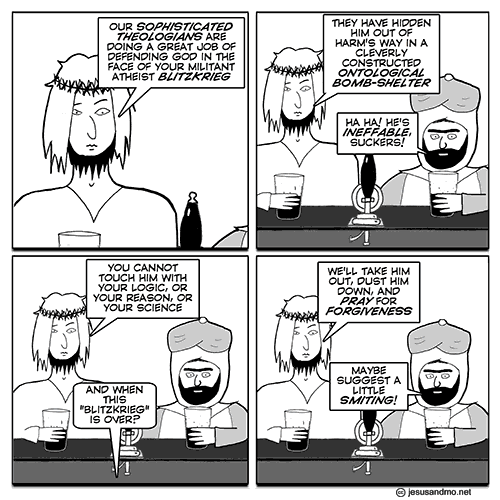
The Ontological Bomb Shelter

Via Jesus and Mo
The best of all possible bomb shelters must exist, because if it didn't exist it wouldn't be a very good bomb shelter now would it?

Saturday, August 18, 2012

Yes, but that last God is a doozy

Richard Dawkins and others often use statements like this one to make the gap between belief and non-belief seem trivial.
An atheist is just somebody who feels about Yahweh the way any decent Christian feels about Thor or Baal or the golden calf. As has been said before, we are all atheists about most of the gods that humanity has ever believed in. Some of us just go one god further.
I myself have used this argument many times, but I just realized today that it may be completely wrong.

As a simple matter of fact it is true that we atheists do believe in one less god than Christians do, but what is farm more important than that is our reasons for disbelief.  On this point, our disbelief in Thor differs greatly from the Christian's disbelief in the same deity.  I would say I don't believe in Thor first and foremost because there is no good evidence for his existence.  A Christian however would say first and foremost that Yahweh/Jehovah/God is the one true God and therefore Thor cannot exist.  Islam even makes this a central creed: "There is no god but Allah."

Believing in a deity that precludes the possibility of any other god existing provides a vastly different basis for disbelief in other gods.  Believers are not (as Dawkins seems to be implying) applying skepticism to all other deities and leaving their own unscathed, they are not applying skepticism at all.

Edit
A quick clarification.  I typically see this quote used in conjunction with an argument like this:
"When you understand why you dismiss all the other possible gods, you will understand why I dismiss yours."
The point is that Christians and Muslims have reasons for disbelieving in other gods that will have no impact on their own belief in their own god.  I think Dawkins is wrong in assuming that they disbelieve in other possible gods for good but unexamined reasons.